
Investigation in to the role of thymosin beta 10 in feline chronic kidney disease
27 July 2026
In 2024, Elisa Vasilopoulou at the Royal Veterinary College received BSAVA PetSavers funding for a PhD to investigate the role of thymosin beta 10 in feline chronic kidney disease. In this report, student Sophie Broughton describes her work.
Chronic kidney disease (CKD) is commonly diagnosed, particularly in the ageing feline population, and is the commonest cause of death in cats over 5 years of age. In most cats, CKD is idiopathic but histologically characterized by tubulointerstitial inflammation and fibrosis. The degree of fibrosis has been shown to correlate with declining kidney function, as nephron loss is a significant consequence of fibrosis. Azotaemia develops when the kidney is no longer able to compensate for the reduced number of nephrons, and this is when clinicians and owners start to appreciate clinical signs. The long-term outcome for cats with CKD is hugely variable; some cats may be stable for years after diagnosis suggesting that pathological changes are progressing slowly or not at all. However, biochemical worsening (progression) is reported in approximately half of cats with CKD receiving IRIS-recommended standard of care, and it is presumed that self-perpetuating pathology exacerbates nephron loss. As might be expected, cats with progressive CKD have shorter average survival times than those with stable disease.
What determines the rate of progression and the pathological mechanisms at play in CKD has not been fully determined, which limits the information available to vets and owners, as well as the treatment options that are available. Quantification of phosphate overload (utilizing serum phosphate and FGF-23) is currently the best marker of progression risk within each IRIS stage, but more markers are needed to predict risk of progression in individual cases. Markers that provide insight into current disease activity and predict the rate of functional kidney tissue disruption could revolutionize how we manage cats with CKD on an individual patient basis. Understanding the heterogenous biological processes that drive or prevent disease progression is also essential for the development of novel treatments to slow nephron loss and maintain renal function. The ultimate goal is to improve the management and welfare of cats with CKD, as well as the impact that a CKD diagnosis can have on cat owners. In this context, one of the current areas of interest is aberrant inflammation and fibrosis that is associated with CKD progression.
What is the role of beta thymosins? Studies in humans and rodents identified that the family of beta thymosin proteins have protective properties in conditions that involve excess inflammation and fibrosis. This research has mainly focused on thymosin beta 4, the most abundant beta thymosin. Research in animal models has demonstrated that thymosin beta 4 has a protective role in the kidney. Lack of thymosin beta 4 accelerated the progression of experimental kidney injury, whilst treatment with thymosin beta 4 lessened disease severity. The role of thymosin beta 10, the second most abundant beta thymosin, is not well defined but there is evidence that thymosin beta 10 expression increases with experimental kidney injury and decreases as the injury resolves.
What data do we have on beta thymosins in cats and what are we exploring? Pilot work in our group identified that the kidney expression of thymosin beta 4 and thymosin beta 10 is higher in cats with progressive CKD compared to non-azotaemic cats. The funding from BSAVA PetSavers is enabling us to investigate further the role of thymosin beta 10 in naturally occurring CKD. We are currently working to identify the location of thymosin beta 10 expression in the feline kidney and investigate if localization changes with CKD. The highlight of this project so far has been validating an antibody that successfully recognizes thymosin beta 10 by immunohistochemistry, enabling us to visualize thymosin beta 10 microscopically in kidney tissue. To identify the specific cells that express thymosin beta 10 in the kidney, we are using dual immunofluorescence. This technique employs multiple fluorescently-labelled antibodies which fluoresce at different wavelengths. This enables us to use one antibody to identify thymosin beta 10, and a second antibody to determine cell type. Immune labelling in cats can be complex due to the limited number of validated antibodies. This has been one of the major challenges of the project, requiring testing of multiple antibodies to correctly identify cells in a positive control tissue without non-specific labelling. Fine-tuning these protocols has allowed us to reliably identify cells such as myofibroblasts, a major pathological cell in renal fibrosis (Figure 1).
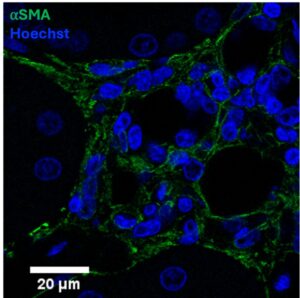
Identifying thymosin beta 10 expression in specific cell types will allow us to start exploring its function in the feline kidney and the cells that may mediate its effects. Leading on from this, we aim to use cell culture to identify how modulating the levels of thymosin beta 10 can affect cell function in vitro. These experiments will determine whether thymosin beta 10 has a protective or pathogenic role in feline CKD and whether it could represent a novel therapeutic target.
Given the potential changes in thymosin beta 10 expression with disease progression, we also plan to explore its use as a biomarker through ELISA development. If results indicate changing disease status or predict future disease behaviour, this could allow primary-care vets to tailor the monitoring of older cats according to their risk and even earmark those that would benefit from certain treatments.
What motivated me to pursue a PhD in feline CKD?
My interest in nephrology developed through my years in general practice managing patients with kidney disease. I shared the frustrations with owners about the limited treatments available, and as I moved into referral practice I recognized that my treatment for feline CKD was largely unchanged. Working at the RVC provided me with the opportunity to not only work alongside the world-leading nephrology/urology team but also develop my skills in clinical research. Whilst I continued with clinical research as a specialist, I felt that this work raised many questions about the pathophysiology of kidney disease and research methodology. I was keen to pursue more focused research training with a PhD, and the excellent mentorship available at the RVC made this programme the obvious choice. Whilst I am only 1 year into this 4-year project, I have already gained so much experience in research techniques, whilst also utilizing problem-solving skills from practice. I have also really appreciated the opportunity to contribute to the RVC Ageing Cat Clinic and be involved in the close monitoring of our cases. The interaction with owners of feline CKD cases is a constant reminder of why we are doing this research.
The team
This project is being undertaken within the RVC Ageing Cat Clinic, which was set up in the early 1990s with funding from BSAVA PetSavers (then known as the Clinical Studies Trust Fund) to investigate diseases of the ageing cat, with a particular focus on CKD, leading to publications.
on the epidemiology, pathology and management of CKD, hypertension and hyperthyroidism. The Research Programme has benefited from 33 years of continuous funding and has trained 16 qualified vets to PhD level in clinical research and published 90 original research papers resulting from its work. The group currently consists of six academics, four of which are clinical specialists in internal medicine, a veterinary nurse and four veterinary PhD students each working on their own project. Case material is accessed through collaboration with two first-opinion veterinary practices in central London, and a large database of cases that have been followed longitudinally in a systematic way is available.
Meet the Researchers
Sophie Broughton
Sophie graduated with distinction from Bristol Vet School and worked in first opinion practice before undertaking both a rotating and medicine internship at Pride Veterinary Centre. She achieved ACVIM board certification after completing an internal medicine residency at the Royal Veterinary College. She remained at the RVC as a research assistant in the feline diabetic remission clinic, and subsequently staff clinician in small animal internal medicine. She started a PhD at the RVC in October 2024.
Elisa Vasilopoulou
Elisa graduated from Aston University in 2006 with a first class BSc (Hons) in applied human biology. She completed her PhD at the University of Birmingham in 2010, and subsequently she undertook postdoctoral research at the University of Birmingham and at UCL. In 2015, Elisa was awarded an intermediate fellowship by Kidney Research UK. She was appointed lecturer in biological sciences at Medway School of Pharmacy, University of Kent in 2018, and in 2021 she joined the Royal Veterinary College where she is currently a senior lecturer in the department of Comparative Biomedical Sciences. Her research focuses on the cellular and molecular mechanisms that underlie kidney disease progression, with a focus on the role of inflammation in kidney injury and repair.
Rosanne Jepson
Rosanne is Professor of Small Animal Nephrology and Internal Medicine at the Royal Veterinary College, where she divides her time between clinical research and clinical duties. Her current research areas include the pathogenesis of feline chronic kidney disease, bacteriuria and urinary tract infections and hypertension, whilst in her clinical work she has interest in all aspects of canine and feline nephrology and urology. Rosanne is a founding member of the American College of Veterinary Nephrology and Urology.
Jonathan Elliott
Jonathan is Professor of Veterinary Clinical Pharmacology and founded the ageing cat clinic in 1992 when he received a grant from the BSAVA Clinical Studies Trust fund to work on secondary renal hyperparathyroidism in the cat. This topic is still an active area of research for the group and an area of focus for Jonathan’s research. He is a diplomate of the European College of Veterinary Pharmacology and Toxicology, an Honorary Diplomate of the American College of Veterinary Internal Medicine and a founding member of the American College of Veterinary Nephrology and Urology.