
Focussing on feline brain health
13 January 2026
The award of a BSAVA PetSavers-funded MSc and an inaugural information day by the Oxford-based International Feline Encephalitis Study Group have focussed on supporting cats with feline autoimmune encephalitis, and their carers.
Autoimmune encephalitis (AE) is emerging as an important cause of new-onset seizures and behaviour change in cats. The most common association is with antibodies targeting a brain protein called leucine-rich glioma-inactivated 1 (LGI1). Encephalitis with LGI1-antibodies is also the most common AE in adult humans, causing comparable symptoms of frequent seizures, personality change, and memory loss.
PetSavers previously awarded research funding in 2020 to Dr Sophie Binks (interviewed in the Companion May 2022 issue), a human neurologist in Oxford who is passionate about helping cats and people with this potentially serious but treatable condition. Dr Binks’ research continues to investigate a wide range of topics in feline AE and how human and veterinary neurologists can work together to tackle the condition across species using a One Health approach.
Our first feline neuroimmunology graduate
From 2023-2024, early career vet Dr Rachel Hall joined the research group and successfully completed a PetSavers-funded MSc exploring laboratory techniques and long-term outcomes in feline AE. With the knowledge and training from the MSc, Rachel is perfectly poised for a career in veterinary neurology and will soon start work as a veterinary neurology intern at The Ralph referral centre in Marlow.
Rachel said: “This MSc has provided me the unique opportunity to work alongside expert clinicians and scientists in the field of AE, and to develop skills in many areas across laboratory-based techniques, clinical cohort research, data analysis, scientific communication and problem solving. It has also engendered an appreciation of the potential One Health approach to medical and veterinary research, to benefit human and veterinary patients alike. It has been an inspiring and humbling process to be a part of this project, and I look forward to carrying what I have learnt into the next stages of my career.”
The first Oxford feline autoimmune encephalitis open day
In March 2025, the Feline Encephalitis Study Group held its first information day at Corpus Christi College, Oxford. The event brought together speakers from human and veterinary neurology, laboratory medicine, PetSavers, and – most importantly – feline caregivers. Attendees, including families of affected cats, first opinion vets, veterinary nurses, and veterinary neurologists, were able to connect with each other and hear a variety of talks about research, treatment and experiences of living with feline AE.
Dr Binks’ opening talk discussed similarities between human and feline AE and some of the recent research findings. The feline encephalitis lab has now received samples from nearly 20 countries of more than 500 cats with seizures, including the USA, Hong Kong, and Australia. A recent publication drew together human and veterinary epilepsy experts to assess videos of seizure events from cats with and without LGI1-antibodies, and identified key features of feline LGI1-related seizures, such as orofacial automatisms (eye blinking, facial twitching, mouth smacking), excessive salivation, and dilated pupils. Some cats also showed ‘circling’ behaviour and cats with LGI1-antibodies typically had multiple seizures per day. Finally, Dr Binks discussed some ongoing owner-focussed research such as a microbiome project.
Dr Abbe Crawford, veterinary neurologist at the Royal Veterinary College, next talked about treating seizures in cats. She explained the challenges of balancing seizure control with medication side effects – as well as acknowledging the difficulty of giving medication to cats! In human AE, steroids, plasma exchange (which removes antibodies from the blood circulation), and other immunotherapies are used. At present, steroids are often started in cats that are not responding to anti-seizure medications (ASMs) alone, but the optimal regime is not well understood, and more advanced immunotherapies have yet to be established in feline practice.
The third talk, from Oxford laboratory medicine expert Dr Hannah Fox, focused on diagnostic testing. Her talk explained that approaches can vary according to whether the antibody target is known (for example, LGI1-antibodies), or if an autoimmune problem is suspected, but with no definite target. Other important considerations include the sample type (e.g. blood or cerebrospinal fluid), amount of available sample, and the test turnaround time. The goal of diagnostic testing is to achieve the “right test, for the right patient at the right time, with the right answer”. For this, tests need to have good ‘sensitivity’ (number of patients with the condition correctly detected) and ‘specificity’ (number of patients without the disease correctly excluded). However, since no test is perfect, results need to be interpreted in the clinical context.
PetSavers’ Dr Sarah Williams closed the session emphasizing the importance of funding veterinary research. She described several successful research projects supported by the charity, including Alzheimer’s Disease-like changes in elderly cats, risk factors for feline gingivitis, and the management of feline hypertrophic cardiomyopathy. Even canines got a mention with an interesting study on helping owners care for their ageing dogs!
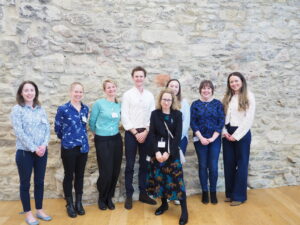
Group photograph of speakers on the day. Back, left to right: Dr Sarah Williams, Dr Abbe Crawford, Dr Adriana Kaczmarska, Dr Ed Ives, Dr Rachel Hall, Dr Hannah Fox, Kelly Kingham. Front: Dr Sophie Binks.
Feline caregivers and their special companions at the centre
After a reviving tea break, the second session focussed on quality of life (QoL) and the caregiver perspective. A talk by Dr Hall analysed responses from feline caregivers in the UK and Germany on the progress of their cats after a diagnosis of LGI1-antibody encephalitis. Evidence in humans suggests that while people do make a good recovery, deeper questioning reveals subtle problems across a range of domains including cognition, mood, fatigue, and QoL. Overall, responses from feline caregivers were reassuring, with most rating their cat’s quality of life as good or excellent. The research also indicates striking similarities to the long-term impacts observed in humans with AE. Measuring these aspects can help assess the efficacy of treatments and inform caregivers of behaviours to watch for in their loved companion.
Presentations from two caregivers of cats with LGI1-antibody associated AE were the highlight of the afternoon. Dr Adriana Kaczmarska, veterinary neurologist from the University of Glasgow, introduced a video talk by the caregiver of Carlos. In April 2023, Carlos, a 14-year-old male neutered domestic short hair cat, was hospitalised after 72 hours of acute-onset seizures and behaviour change. Thanks to the neurology team at Glasgow’s care and treatment with both ASMs and immunotherapy, he survived a stormy illness and was discharged home. In the talk, we learnt about the emotional impact of his diagnosis, and how the whole family’s life changed to put Carlos’ needs at the heart of their routine, and to maximise the time they spent with him. One year later, Carlos died of medical complications following his AE diagnosis. Carlos’ caregiver, an author, now plans to write a feline-themed book featuring AE cats as characters.
We also learned the story of another cat, River Bea, a female neutered Ragdoll cat whose signs started when she was 18 months old. River’s signs started with occasional brief episodes of hypersalivation and standing still, with her ears held back. These progressed to multiple daily episodes of full body stiffening, lifting her paw in the air, circling, bumping into objects, and then falling over and lying on her side. River was started on phenobarbitone and 2 years later is doing well, back to her normal self, enjoying bird watching in the garden and play time with her brother Ralph.
The day closed with an expert panel Q&A where speakers were joined by Dr Ed Ives, veterinary neurologist at Anderson Moores Veterinary Specialists. The discussion highlighted the need to improve our knowledge of effective treatment for feline AE, and ways to raise awareness, particularly among first opinion practice. The caregivers also commented that they had found great support from meeting and connecting with others: “I found it so useful to meet other feline caregivers that have cats that are experiencing the same condition”, read one feedback form comment.
There was even positive feedback from the felines themselves, with one expressing approval of the notebooks that were provided as part of the welcome packs!
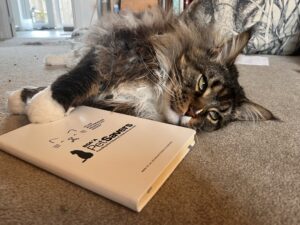
Recovered patient Bilbo relaxes with his new notebook
Find out more by visiting the International Feline Encephalitis Study Group website at https://www.rvc.ac.uk/research/feline-encephalitis
Support BSAVA PetSavers to fund more clinical research to advance pet health by donating here: www.bsava.com/petsavers/donate
Reference
Binks SNM, Crawford AH, Ives E, et al. Distinctive seizure signature in the first video case-control study of a naturally-occurring feline autoimmune encephalitis model. Brain Behav Immun. 2025 May:126:289-296. Available at: https://doi.org/10.1016/j.bbi.2025.02.018